Mastering Your 401(k) Allocation: 2026 Strategies for Volatile Markets

Anúncios
Optimizing Your 401(k) Allocation in 2026: Strategies to Counteract 15% Market Volatility
The year 2026 promises to be a pivotal one for investors, with projections indicating potential market volatility reaching up to 15%. For those diligently saving for retirement through a 401(k), understanding how to strategically optimize your 401(k) allocation is not just advisable, but essential. The stakes are high, and a well-thought-out approach can mean the difference between weathering economic storms and seeing your hard-earned savings eroded. This comprehensive guide will delve into the critical strategies you need to implement to safeguard and grow your retirement nest egg in the face of anticipated market fluctuations.
Anúncios
Understanding the 2026 Market Landscape and Its Impact on Your 401(k)
Before we dive into specific strategies, it’s crucial to grasp the potential challenges and opportunities that the 2026 market environment might present. Economic forecasts suggest a period marked by elevated inflation concerns, evolving interest rate policies, and geopolitical shifts that could collectively contribute to significant market swings. A 15% volatility projection implies that asset values could fluctuate considerably, presenting both risks for losses and opportunities for gains if managed effectively. Your existing 401(k) allocation might be well-suited for stable periods, but a volatile market demands a more dynamic and resilient strategy.
Many investors, especially those nearing retirement, tend to adopt a more conservative 401(k) allocation. However, even conservative portfolios are not immune to volatility. Understanding the correlation between different asset classes during turbulent times is key. For younger investors, volatility can be an opportunity to buy assets at lower prices, accelerating long-term growth. For those closer to retirement, capital preservation becomes a more pressing concern, necessitating a careful balance of risk and return.
Furthermore, the availability of various investment options within your 401(k) plan will play a significant role. Some plans offer a wide array of funds, including target-date funds, index funds, actively managed funds, and even alternative investments, while others might be more limited. Knowing your options is the first step in formulating an effective 401(k) allocation strategy. Evaluating the expense ratios of these funds is also vital, as high fees can significantly erode returns over time, especially in a volatile market where every basis point counts.
Anúncios
The Cornerstone of Resilience: Diversification and Asset Allocation in Your 401(k)
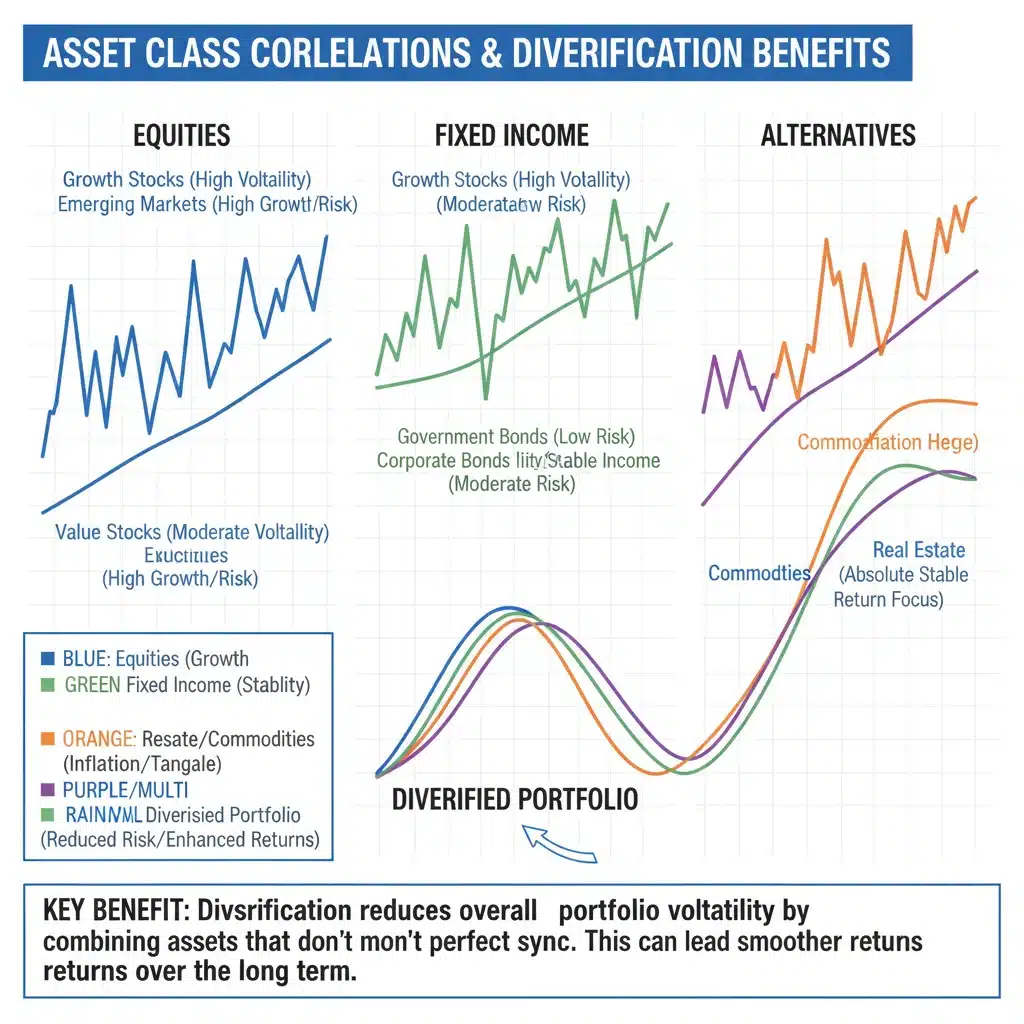
The most fundamental principle for navigating market volatility is robust diversification. A well-diversified 401(k) allocation means spreading your investments across various asset classes, industries, geographies, and even investment styles. The goal is to ensure that no single asset class or sector has an outsized impact on your overall portfolio’s performance. When one segment of the market struggles, another might perform well, cushioning the blow and providing stability.
Strategic Asset Allocation for 2026
Your asset allocation—the mix of stocks, bonds, cash, and potentially alternative investments—should be tailored to your risk tolerance, time horizon, and financial goals. In a potentially 15% volatile market, a thoughtful asset allocation becomes even more critical. Here’s how to approach it:
- Equities (Stocks): While stocks offer the highest potential for long-term growth, they also carry the highest risk. For 2026, consider diversifying your equity holdings across different market capitalizations (large-cap, mid-cap, small-cap), sectors (technology, healthcare, consumer staples, industrials), and geographies (domestic, international, emerging markets). This broad exposure can help mitigate the impact of downturns in specific areas. Growth stocks, while exciting, can be more susceptible to volatility. Value stocks, often overlooked, might offer more stability in a turbulent environment.
- Fixed Income (Bonds): Bonds typically provide stability and income, acting as a ballast against stock market fluctuations. However, rising interest rates can negatively impact bond prices. For 2026, consider a mix of short-term, intermediate-term, and potentially inflation-protected securities (TIPS) to hedge against both interest rate risk and inflation. High-yield bonds offer higher returns but come with increased credit risk, which might be amplified in a volatile market. Investment-grade corporate bonds and government bonds generally offer more security.
- Cash and Cash Equivalents: While not a growth engine, a strategic allocation to cash can provide liquidity and a buffer during downturns, allowing you to seize buying opportunities when assets are undervalued. This is particularly important in a 15% volatile market, where quick access to funds can be advantageous. However, holding too much cash can lead to erosion of purchasing power due to inflation.
- Alternative Investments (if available in your 401(k)): Some advanced 401(k) plans might offer access to real estate investment trusts (REITs), commodities, or even private equity funds. These can offer diversification benefits because their returns often have a low correlation with traditional stocks and bonds. However, they also come with their own set of risks and liquidity considerations.
The key is to find a 401(k) allocation that aligns with your personal risk profile. A younger investor with decades until retirement might comfortably maintain a higher equity allocation (e.g., 80% stocks, 20% bonds), while someone five years from retirement might opt for a more conservative mix (e.g., 40% stocks, 60% bonds). Regularly reviewing and adjusting this mix is part of effective 401(k) allocation management.
The Power of Rebalancing: Keeping Your 401(k) Allocation on Track
Even the most meticulously planned 401(k) allocation can drift over time due to market movements. This is where rebalancing comes into play. Rebalancing involves periodically adjusting your portfolio back to its original target asset allocation. For instance, if your target is 60% stocks and 40% bonds, and a stock market rally causes stocks to comprise 70% of your portfolio, you would sell some stocks and buy bonds to return to your desired 60/40 mix.
Why Rebalancing is Crucial in 2026
In a market with 15% volatility, regular rebalancing is paramount for several reasons:
- Risk Management: It prevents your portfolio from becoming too concentrated in assets that have performed exceptionally well, which might now be overvalued and prone to correction. Conversely, it forces you to buy assets that have underperformed, potentially at a discount.
- Discipline: Rebalancing imposes a disciplined, systematic approach to buying low and selling high, removing emotional biases from investment decisions. This is especially valuable during volatile periods when fear and greed can lead to poor choices.
- Maintaining Your Risk Profile: It ensures your 401(k) allocation continues to align with your comfort level for risk. Without rebalancing, a high-growth asset could grow to dominate your portfolio, inadvertently increasing your overall risk exposure beyond what you are comfortable with.
How Often Should You Rebalance Your 401(k)?
There are two primary approaches to rebalancing:
- Time-Based Rebalancing: This involves reviewing and adjusting your 401(k) allocation at fixed intervals, such as annually or semi-annually. This method is straightforward and ensures regular portfolio check-ups. For a volatile 2026, semi-annual rebalancing might be more appropriate than annual.
- Threshold-Based Rebalancing: This approach triggers a rebalance when an asset class deviates by a certain percentage from its target allocation (e.g., +/- 5% or 10%). This can be more reactive to market movements and might lead to more frequent rebalancing during highly volatile periods, which could be beneficial in 2026.
Many 401(k) plans offer automated rebalancing features, particularly for target-date funds. If your plan allows it, leveraging these features can simplify the process and ensure your 401(k) allocation remains optimized without constant manual intervention. However, it’s still wise to periodically review the automated settings to ensure they align with your current financial situation and market outlook.
Beyond Diversification: Advanced Strategies for Your 401(k) in 2026
While diversification and rebalancing are foundational, there are other sophisticated strategies to consider for your 401(k) allocation in a 15% volatile market.
Dollar-Cost Averaging
Most 401(k) contributions are made through regular payroll deductions, which inherently implement dollar-cost averaging. This strategy involves investing a fixed amount of money at regular intervals, regardless of market fluctuations. When prices are high, your fixed contribution buys fewer shares; when prices are low, it buys more shares. Over time, this averages out your purchase price, reducing the risk of investing a large sum at an unfavorable market peak. In a volatile market, dollar-cost averaging is your silent partner, turning downturns into opportunities to acquire more assets at lower prices.
Considering Target-Date Funds
Target-date funds are a popular option within 401(k) plans, especially for those who prefer a hands-off approach. These funds automatically adjust their asset allocation over time, becoming more conservative as you approach your target retirement date. While convenient, it’s crucial to understand their underlying holdings and expense ratios. Some target-date funds might not perfectly align with your individual risk tolerance, especially in a year like 2026. Reviewing their glide path (how their asset allocation changes) is essential to ensure it suits your needs.
Risk-Adjusted Returns and Portfolio Stress Testing
For those who want a deeper dive, consider evaluating your 401(k) allocation based on risk-adjusted returns. Metrics like the Sharpe ratio or Sortino ratio can help you understand how much return you’re getting for the level of risk you’re taking. Furthermore, imagine stress-testing your portfolio: how would your current 401(k) allocation perform under various adverse scenarios, such as a prolonged recession, a significant interest rate hike, or a major geopolitical event? While you can’t predict the future, understanding potential vulnerabilities can help you adjust proactively.
For example, if your stress test reveals that a significant portion of your portfolio is highly correlated with a particular sector that is susceptible to economic downturns, you might consider diversifying further into less correlated assets. This proactive approach to managing your 401(k) allocation can significantly enhance its resilience.

The Role of Your Age and Time Horizon in 401(k) Allocation
Your stage of life is a paramount factor in determining the optimal 401(k) allocation. The general rule of thumb is that younger investors, with a longer time horizon, can afford to take on more risk, while those nearing or in retirement should prioritize capital preservation.
Early Career (20s-30s)
With several decades until retirement, investors in this age group have the luxury of time to recover from market downturns. A higher allocation to equities (e.g., 80-90%) is often recommended, focusing on growth-oriented investments. Even with 15% market volatility in 2026, these fluctuations can be seen as opportunities to buy assets at lower prices, accelerating long-term compounding. Diversification across various equity types (U.S., international, small-cap, large-cap) is still crucial.
Mid-Career (40s-50s)
As retirement draws closer, a gradual shift towards a more balanced 401(k) allocation is prudent. While equities should still form a significant portion of the portfolio (e.g., 60-75%), increasing exposure to fixed income can help reduce overall portfolio volatility. This period is also ideal for reviewing your overall financial plan, including college savings, mortgages, and other financial goals, to ensure your 401(k) allocation aligns with your broader financial picture.
Late Career/Pre-Retirement (50s-60s)
Capital preservation becomes increasingly important. A more conservative 401(k) allocation, with a higher percentage in fixed income and cash equivalents (e.g., 40-50% equities, 50-60% fixed income), is generally advised. The goal is to minimize the impact of significant market downturns, as there is less time to recover losses. However, completely abandoning equities might not be wise, as some growth is still needed to combat inflation and ensure your savings last throughout retirement. A careful balance is key.
In Retirement (60s+)
For those already in retirement, the 401(k) allocation often shifts to focus on generating income and preserving capital. A significant portion will likely be in bonds, cash, and dividend-paying stocks. The ‘bucket strategy,’ where different portions of your portfolio are allocated for short-term, medium-term, and long-term spending, can be an effective way to manage withdrawals and navigate market volatility. Even in retirement, a small allocation to growth assets can help your portfolio keep pace with inflation.
Monitoring and Adapting Your 401(k) Allocation
The financial landscape is ever-changing, and 2026’s projected 15% volatility underscores the need for continuous vigilance. Your initial 401(k) allocation is a starting point, not a static destination. Regular monitoring and adaptation are critical to long-term success.
Periodic Reviews
Set a schedule for reviewing your 401(k) allocation at least annually, or more frequently during periods of high volatility. During these reviews, ask yourself:
- Has my risk tolerance changed?
- Are my financial goals still the same?
- Have there been significant life events (marriage, children, job change, health issues) that impact my financial situation?
- How has my portfolio performed relative to its benchmarks and my expectations?
- Are the expense ratios of my chosen funds still competitive?
Staying Informed
While you don’t need to be a market expert, staying generally informed about economic trends, interest rate policies, and geopolitical events can help you anticipate potential market shifts. This knowledge can inform your decisions regarding your 401(k) allocation, allowing for proactive adjustments rather than reactive panic. However, avoid making impulsive decisions based on daily news cycles; focus on long-term trends.
Consulting a Financial Advisor
For many, navigating the complexities of 401(k) allocation, especially in a volatile market, can be overwhelming. A qualified financial advisor can provide personalized guidance, help you assess your risk tolerance, develop an appropriate asset allocation strategy, and assist with rebalancing. They can also provide a valuable objective perspective, helping you avoid emotional investment decisions that can be detrimental during turbulent times. Even if your 401(k) plan is self-directed, an advisor can help you make informed choices within the available options.
Common Pitfalls to Avoid with Your 401(k) in 2026
In a volatile market, certain behavioral biases and common mistakes can severely impact your 401(k) performance. Being aware of these can help you avoid them.
- Panic Selling: This is perhaps the most damaging mistake. When markets drop, the instinct to sell and ‘stop the bleeding’ is strong. However, selling during a downturn locks in losses and prevents you from participating in the inevitable recovery. Remember, market corrections are a normal part of investing.
- Chasing Returns: Conversely, don’t get caught up in the hype of assets or sectors that have recently performed exceptionally well. These often become overvalued and are ripe for correction. Stick to your long-term 401(k) allocation strategy.
- Ignoring Fees: High expense ratios, even seemingly small percentages, can compound over decades and significantly erode your returns. Always be aware of the fees associated with the funds in your 401(k) and opt for low-cost index funds or ETFs when appropriate.
- Lack of Diversification: Putting all your eggs in one basket, whether it’s a single stock, sector, or even a single country, exposes you to immense risk. Ensure your 401(k) allocation is truly diversified.
- Setting and Forgetting: While hands-off investing has its merits, completely neglecting your 401(k) allocation can lead to it drifting significantly from your target risk profile. Regular reviews and rebalancing are essential.
Conclusion: Proactive 401(k) Allocation for a Resilient Future
Optimizing your 401(k) allocation in anticipation of 2026’s projected 15% market volatility is a proactive step towards securing your financial future. By embracing intelligent diversification, committing to regular rebalancing, understanding the impact of your age and time horizon, and avoiding common pitfalls, you can build a resilient portfolio capable of navigating economic uncertainties. Remember, investing for retirement is a marathon, not a sprint. A well-thought-out and consistently managed 401(k) allocation strategy will serve as your compass, guiding you through market fluctuations and towards a comfortable retirement.
Take the time now to review your current 401(k) allocation, assess your risk tolerance, and make any necessary adjustments. The effort you put in today will pay dividends in the years to come, ensuring your retirement savings are not just protected, but positioned for continued growth, even in the face of significant market shifts. Your financial future in 2026 and beyond depends on these strategic decisions.